May 18, 2026—There is a difference between being a nationality that is oppressed and being a nationality that is oppressing others. Oppressors understand this, which is why they always claim victimhood. They think it gives them cover.
The oppressed don’t have to lie.
I recently finished reading a great but difficult book: Here Where We Live Is Our Country: The Story of the Jewish Bund, written and illustrated by Molly Crabapple.
Difficult because of the decades of oppression of Jews in the Pale of Settlement, the area where Jews were permitted to live in the Tsarist Russian Empire, which now is parceled out among a number of countries, including Lithuania, Belorus, Ukraine, and Poland.
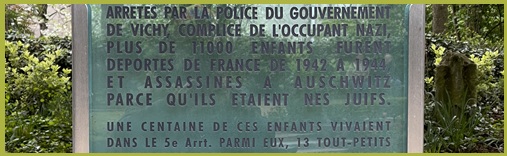
It’s hard to read about real people being systematically murdered during the 50-year period ending with the Holocaust. I usually avoid this kind of thing. I know about it. My reservoir of horror is filled. But my grandparents came to this country before World War I to escape this and, once in a while there’s a new angle on the story. So when I heard that a book on the Bund was being released, I ordered it immediately. I was in Paris at the time. The book waiting for me when I got home from the trip.
I mention Paris because I recently learned of a relative of my Zadie (my grandfather who was born Osher Yefroikin) who was an important figure in refugee resettlement in France, both before and after World War II.
I only know snippets about him (Yisroel Yefroikin) and I thought he was a member of the Bund. So I was curious to learn about him and an organization that was such an important part of Jewish life in the Pale when my grandparents (all 4 of them) lived there, but largely disappeared after the Holocaust. It’s an important part of the story.
So here is what I learned. There were three mass movements that grew up in Jewish communities in the Pale at the end of the 19th century. One movement migrated, mostly, to America, to escape the pogroms that were occurring. Another movement organized around the idea of migrating back to the ancestral homeland in Palestine. That was Zionism.
The third movement was the Bund. The Bund was socialist—or what today we would call democratic socialist. They believed in the rights of all people, but thought it was important to fight for oppressed Jews to have full equality of rights “here where we live.” They sought allyship among other socialist movements of the time, but were mostly spurned—especially by the nascent communists in Russia.
Before I go on, I want to note that there must certainly have been other Jewish groups in the Pale that were not extensively discussed in this book (except as victims of the horrors). There had to have been folks who simply were not involved in the political ferment.
This would have included both religious and assimilated Jews. The were just trying to get along. . . . Or they were trying to escape but couldn’t as the doors of the West slammed shut beginning in the 1920s. There are always people who are apolitical, but trapped nevertheless. We shouldn’t forget them.
So, the book didn’t mention my long-lost relative Yisroel Yefroikin, but I did learn that the question of whether an organizer for refugee resettlement would be a member of the Bund can’t be settled simply. Some resettlers would have tried to send folks to America, some to Palestine, and some (the Bund) would have tried to resettle displaced people in their homes (Here Where We Live). So, for the moment, I don’t know about Yisroel Yefroikin, though it seems clear that he was doing good work.
The Bund and the Zionists were not allies. In fact, the Bund felt that the Zionists were pursuing a colonial enterprise that would be displacing other people (Palestinians). This does not appear to be a reinterpretation of history. They felt that nationalism was inherently undemocratic. The animosity between the two groups was severe.
Molly Crabapple is very clear on where her sympathies lie—with the Bund. And she illustrates how the Zionists went from being the oppressed to being the oppressors, as predicted by the Bund. The parallels between the destruction of Gaza and the destruction of (for example) the Warsaw Ghetto are stark and terribly disheartening.
The Bund lost its struggle with the Zionists thanks to the Holocaust. Here Where We Live became too horrible. Some Bundists came to America and established workingmen’s circles and worked to preserve Yiddish language and culture. Others became ash in the ovens. Other, no doubt, became Zionists.
But the question that separated Bundists and Zionists persists. It’s the question that I started this post with. Is there a difference between nationalism of the oppressed and nationalism of the oppressor?
In spite of the wars, I still think there is a difference. You can see this among White Christian Nationalists who manufacture fake grievances against people of color and non-Christians to support their oppressive agenda.
On the other hand, around the world, truly oppressed people rise up to demand dignity. But what happens when an oppressed people wins?
Did the Bund have the solution? And was the solution lost in the butchery of the Holocaust?
Look. The Bund did not have a solution to the Holocaust. No one did. At least no one of goodwill. The German people could have ended it without bloodshed. But they wallowed in their grievances. And whatever grievances that had that were legitimate were not grievances against Jews. But Jews were an easy target and the European culture made it easy to go after them.
Without honesty in Germany, it took the combined forces of the allies–and 10s of millions dead to stop the oppression.
It’s the oppression that’s the problem, not the resistance. Without oppression there would be no resistance. . . . One would hope.
* * *
Finally, here is a normal review of this book, pointing out some of its flaws: Molly Crabapple’s book is well researched but ideologically biased, by Mikhail Krutikov, which appeared in the Forward.
* * *
What do you think? Scroll down to comment
Like what you read? Share with your friends.
If you are new to EightOh9, check out the site and let me know what you think.

